
AI Coding and Writing Things Down
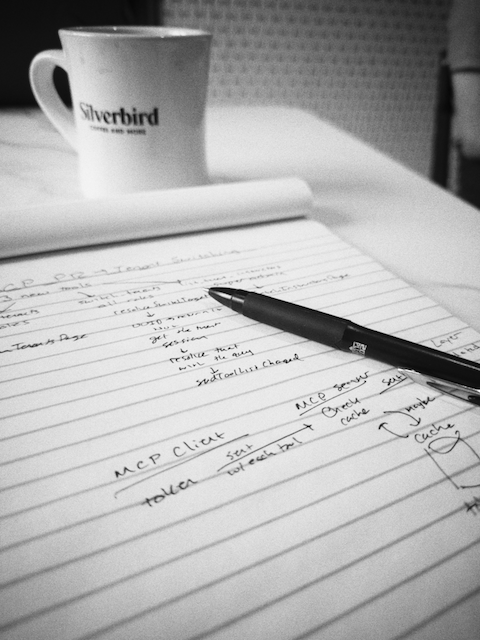
When I'm coding now, I write out the problem I'm working on, what I expect the outcome to look like, the structure of the system, before I ever hand it to an agent. The simple act of putting pen to paper forces me to understand, to probe, to strain my mind in a way that keeps it sharp.
A few weeks ago an agent quickly solved something in one shot that would’ve taken me hours, or even days-it was one of those convoluted problems that in the past I'd need to resign myself to chewing on all day. I've had a lot of these moments over the last couple of years. I call them "whoa, what's my job" moments.
I was a very early adopter of agentic coding tools. I loved the speed at which I could move and how good the models were at the mundane stuff. As they've improved, those "whoa" moments have stacked up, and somewhere along the way I mostly stopped writing code by hand. This isn't unique to me. Boris Cherny, the creator of Claude Code, has talked extensively about giving it up himself. Plenty of others have said the same. At the startup where I work, I'd estimate 90% or more of our code is now written by an agent.
I'm not pointing this out as a problem, and I'm definitely not anti-AI. However, while working more and more with the models and with people using the models, I've started to notice something happening to me, and to people around me—something Lars Faye recently put words to. If I spend all my time managing agents that do the work I used to do, and none of it keeping my own skills sharp, I eventually lose the ability to manage those agents well. I also lose my connection to the craft I've grown to love. I don't think I've gone far down that path, but it's clear how easy it would be. And the person at the end of that path has lost the expertise and taste that make them valuable in their work and, more than that, make them a fuller human. That's the part I take seriously.
Here's the thing I keep coming back to, though: the same technology that can hollow out your thinking can be pointed the other way. LLMs are incredibly powerful tools. They aren't going to change things; they're actively changing them now. What I do at work today is radically different from what I did two years ago. Anthropic recently released Claude Fable 5, a step change better than what we'd been using for months, and we're still early on the growth curve of AI. The question isn't whether the tools reshape us. It's whether we’ll be shaped to think more or less.
For me, the solution has been almost embarrassingly low-tech: I write things down. On paper. When I'm coding now, I write out the problem I'm working on, what I expect the outcome to look like, the structure of the system, before I ever hand it to an agent. The simple act of putting pen to paper forces me to understand, to probe, to strain my mind in a way that keeps it sharp. The agent does more of the typing; I do more of the thinking. That's the trade I want.
That “pen to paper” ethos is why we built Writually. It asks you to spend some time each day putting thoughts on paper and investing in your own brain and creativity instead of outsourcing them. And yes, there's AI under the hood, but leveraged deliberately: it gives you prompts to write about, questions to follow up on, and themes pulled from what you've written to push your thinking further. It's one example of a different kind of app: one that doesn't ask you to surrender your thinking or creativity to AI, but uses it to make you think more, create more, and stay cognitively fit.
Cognitive Fitness Isn't Just a Metaphor
So the idea of writing as a brain workout isn’t just a metaphor for Writually. A good pen is just setting yourself up with the right gear.
A few years ago at the SXSWedu conference, I was wandering the exhibit hall and noticed a large crowd at one particular booth. It wasn’t the latest edtech platform with a wittily compounded name. It was one of the oldest tools in the education toolkit: pens. Conference attendees were lining up for a free pouch of the latest innovations from Pilot.
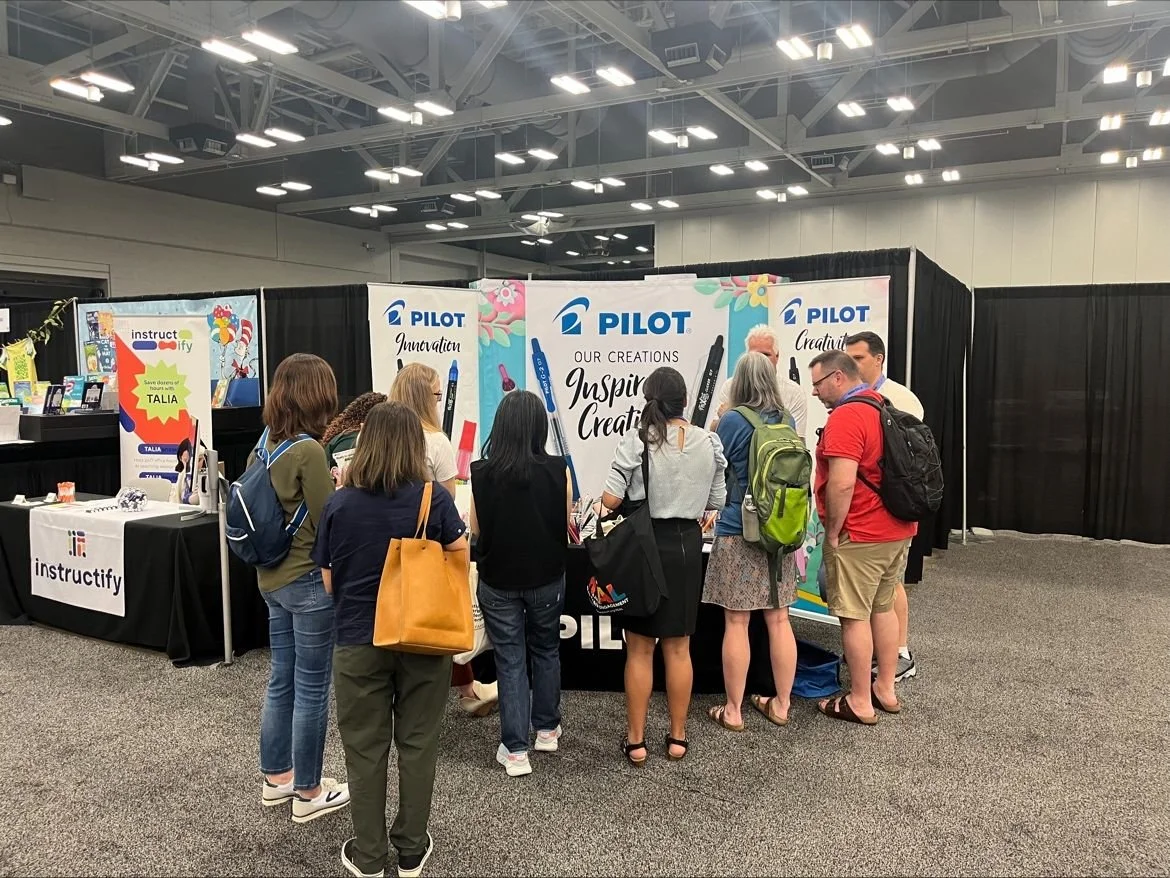
Lining up for free pens at SXSWedu
Though I work in edtech and believe technology can help instructors and students teach and learn better, I found it heartening that the humble pen was giving the latest innovations a run for their money. Or at least was still getting lots of attention. People still wanted pens amidst the digitization and simulation of all the things.
Writually is all about cultivating a practice around the embodied experience of writing. From the start, we imagined that we would eventually have a marketplace where we would sell pens and journals and other tools of the trade. For our initial friends and family pilot, we decided to invest in sending everyone a writers’ care package complete with nice journals and pens.
We spent a lot of time thinking about which pen and which journal! We turned to one of our inspirations for the Writually project, Cal Newport, for a recommendation. His top pick is the uniball™ ROLLER. As we’ve mentioned before, Cal is known for thinking and writing on the idea of “deep work” so it makes sense he’s serious about pens and the analog practice of writing on paper generally.
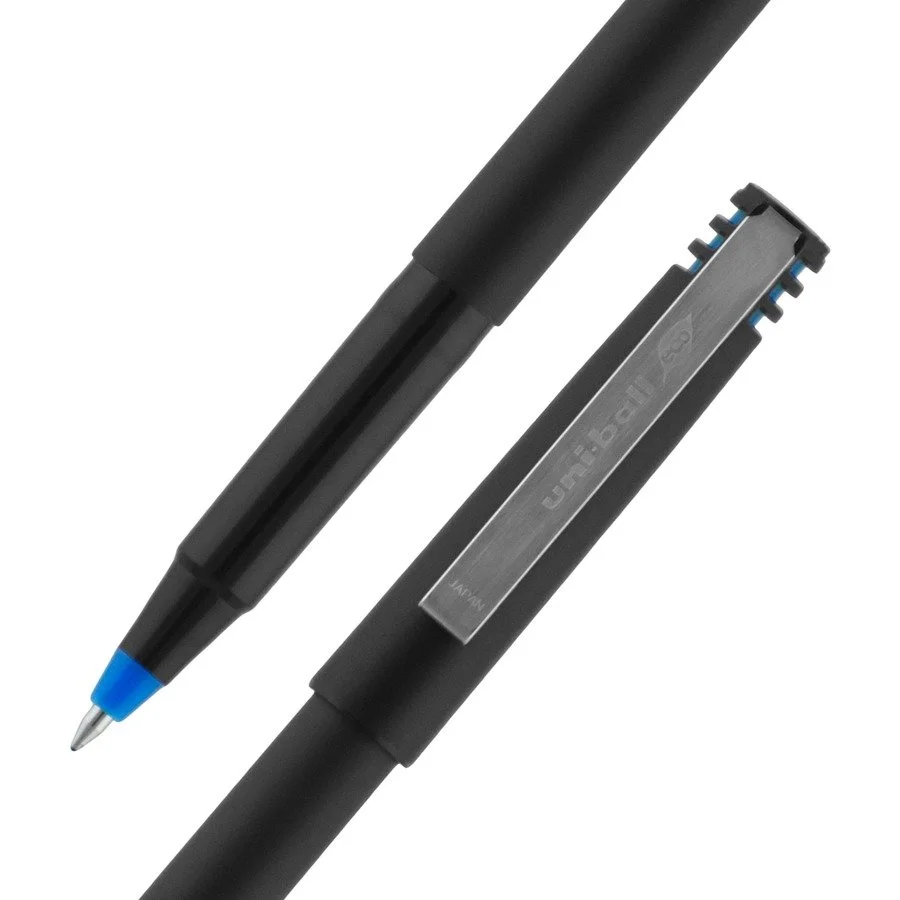
The uniball ROLLER will “Elevate your everyday writing experience”
There’s actually strong research around the importance of a good pen, or, more directly, the cognitive and emotional benefits of longhand writing. The evidence ranges from the famous “The Pen is Mightier Than the Keyboard” study on student notetaking and learning (learning improves with handwritten note-taking) to James Pennebaker’s scholarship on the therapeutic benefits of writing, as in his book Open Up By Writing It Down.
Recent research supports one of the big ideas behind Writually: cognitive fitness is similar to physical fitness. The authors of "Handwriting but not typewriting leads to widespread brain connectivity" used EEG technology to measure brain activity during handwriting versus typing — and the difference is stark. Handwriting produced 16 significant neural connections firing simultaneously. Typing produced effectively zero. The brain isn't just working differently when you write by hand; it's working at a fundamentally higher level of engagement.
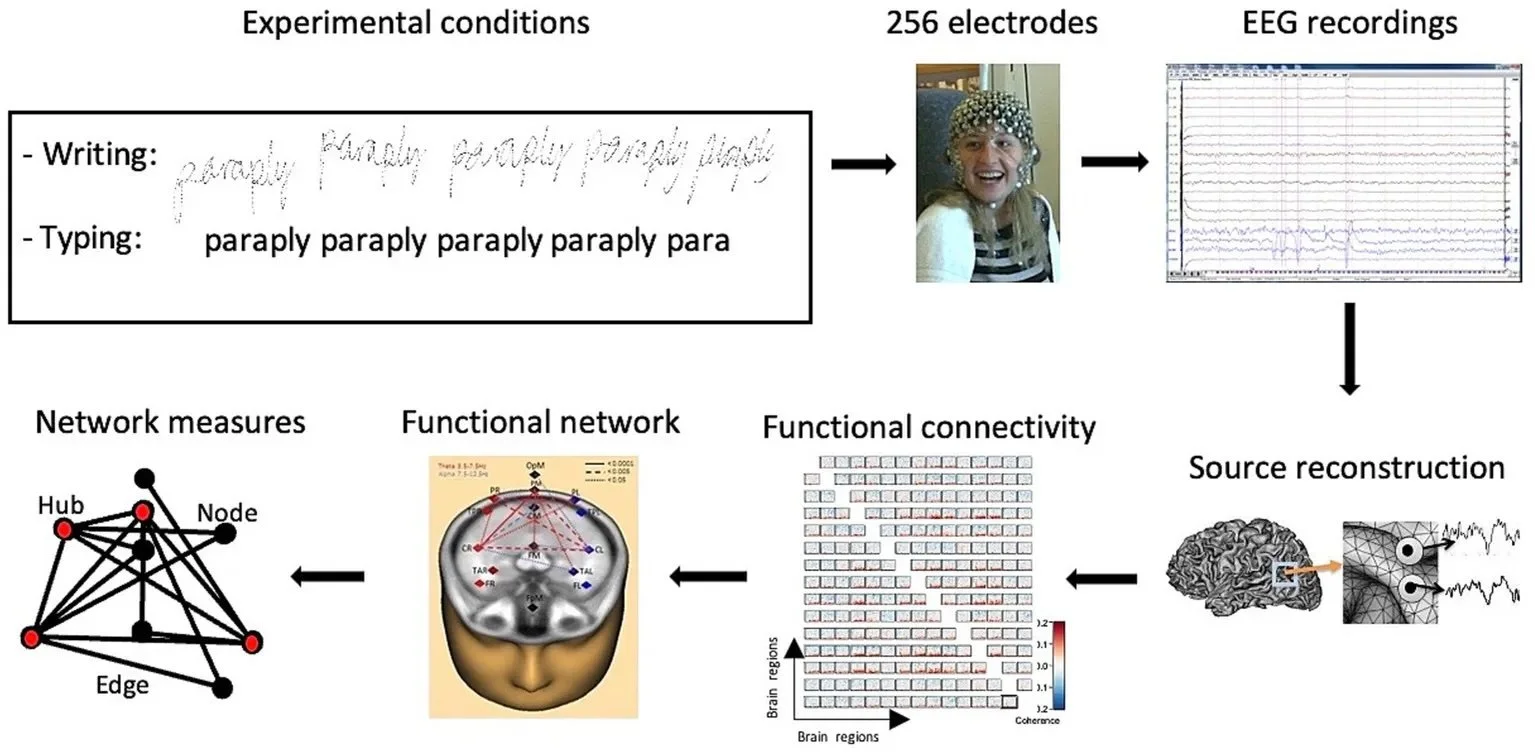
How the study worked: participants wrote or typed the same words while wearing a 256-electrode EEG cap, and researchers mapped the neural connections firing in each condition
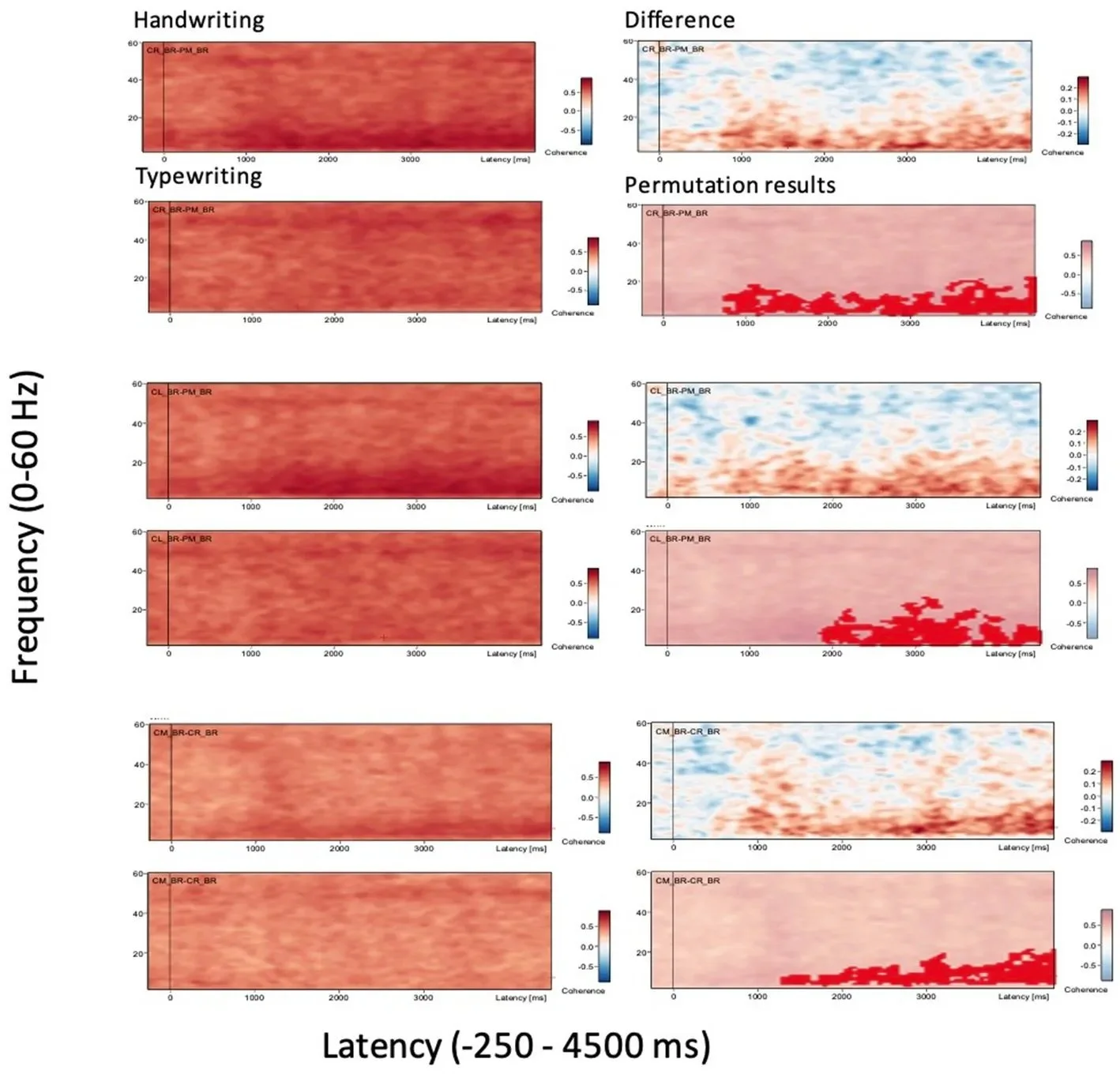
What the brain looks like during handwriting versus typing
It makes sense when you think about what each activity actually demands. Typing is largely repetitive: the same mechanical keypress, over and over, regardless of the letter. Handwriting requires constant fine motor control, shaping each letter through a series of precise, varied movements, all while your brain integrates what your hand feels, what your eye sees, and what your mind intends. Maybe typing is the equivalent of just using one machine at the gym. Handwriting is making use of the full range of equipment.
So the idea of writing as a brain workout isn’t just a metaphor for Writually. And a good pen is the right gear for the routine.
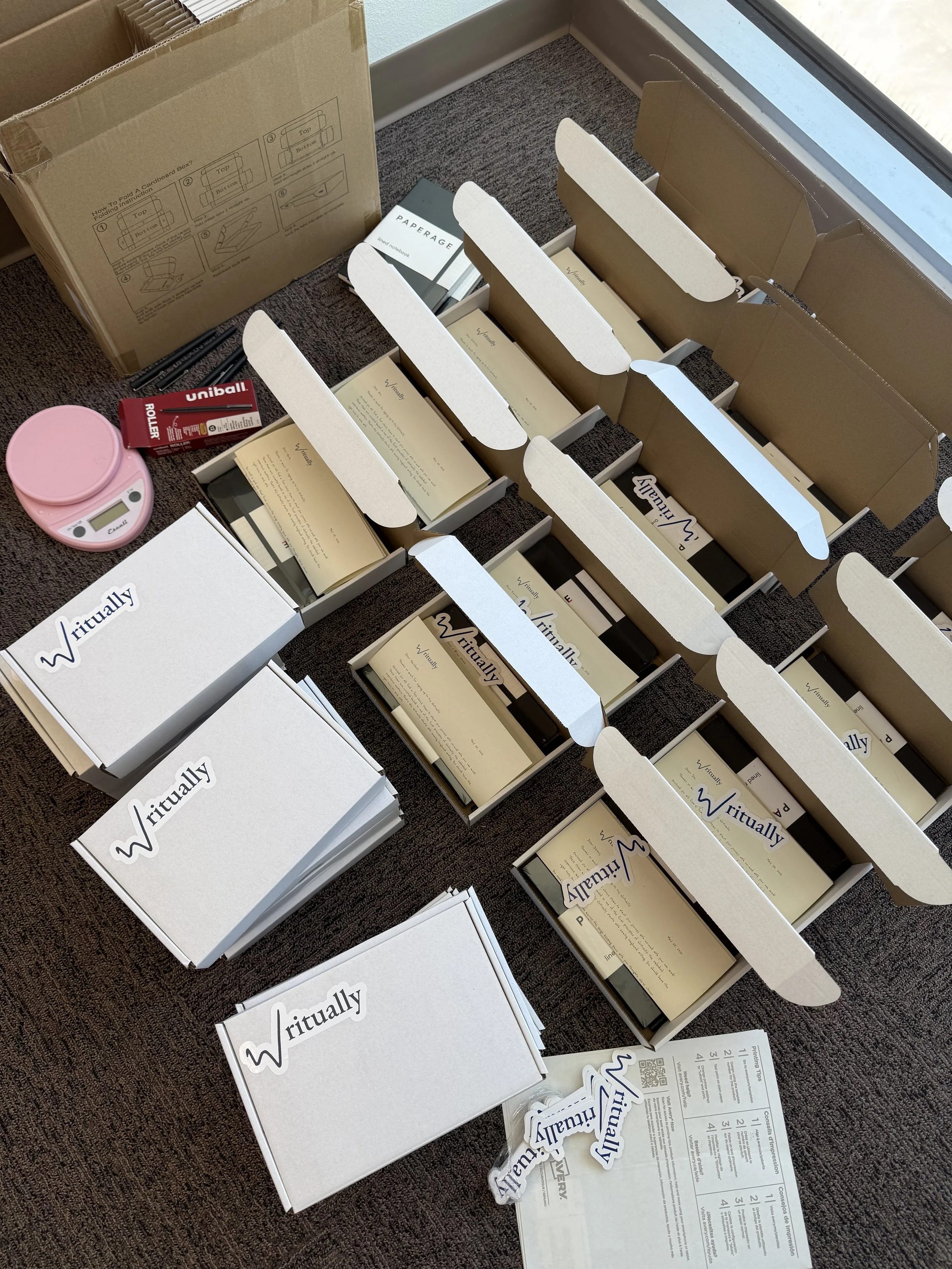
Assembling the Writually writers’ care packages for our trial cohort
It’s been fun packing up the writers’ care package boxes to send to our trial cohort this week. I realize it’s a post-Covid white collar problem, but, as a remote employee for a tech company, so much of the work I do in the world is delivered digitally. It’s nice to put my hands on real stuff and shape not just a box but an experience to be lived in the real world.
We’re including a letter from the founders in the package, printed out on a resume-quality cardstock-–is that a thing anymore? To be fair, we didn’t handwrite the letters, but we used Reenie Beanie to approximate the feel of longhand and captured our real signatures as digital images. Hopefully this little gift will extend into the experience of writing itself for our first cohort of Writually users.
How Writually Began with a Newspaper Article, a Pen, and a Marginal Note
What if we could do for cognitive fitness what apps like Apple Health and Strava have done for physical fitness? What might an app for the mental sports of reading and writing look like?
At the moment, there is a clipped newspaper article on the wall above my desk held in place by pushpins. It is creased from folding, already yellowing from sunlight though just a month old, and marked up by a pen. Next to a paragraph about the mental effort of writing, I have circled a couple of sentences with pen ink. Later in the article, I wrote a note to myself. These marginalia eventually became Writually.
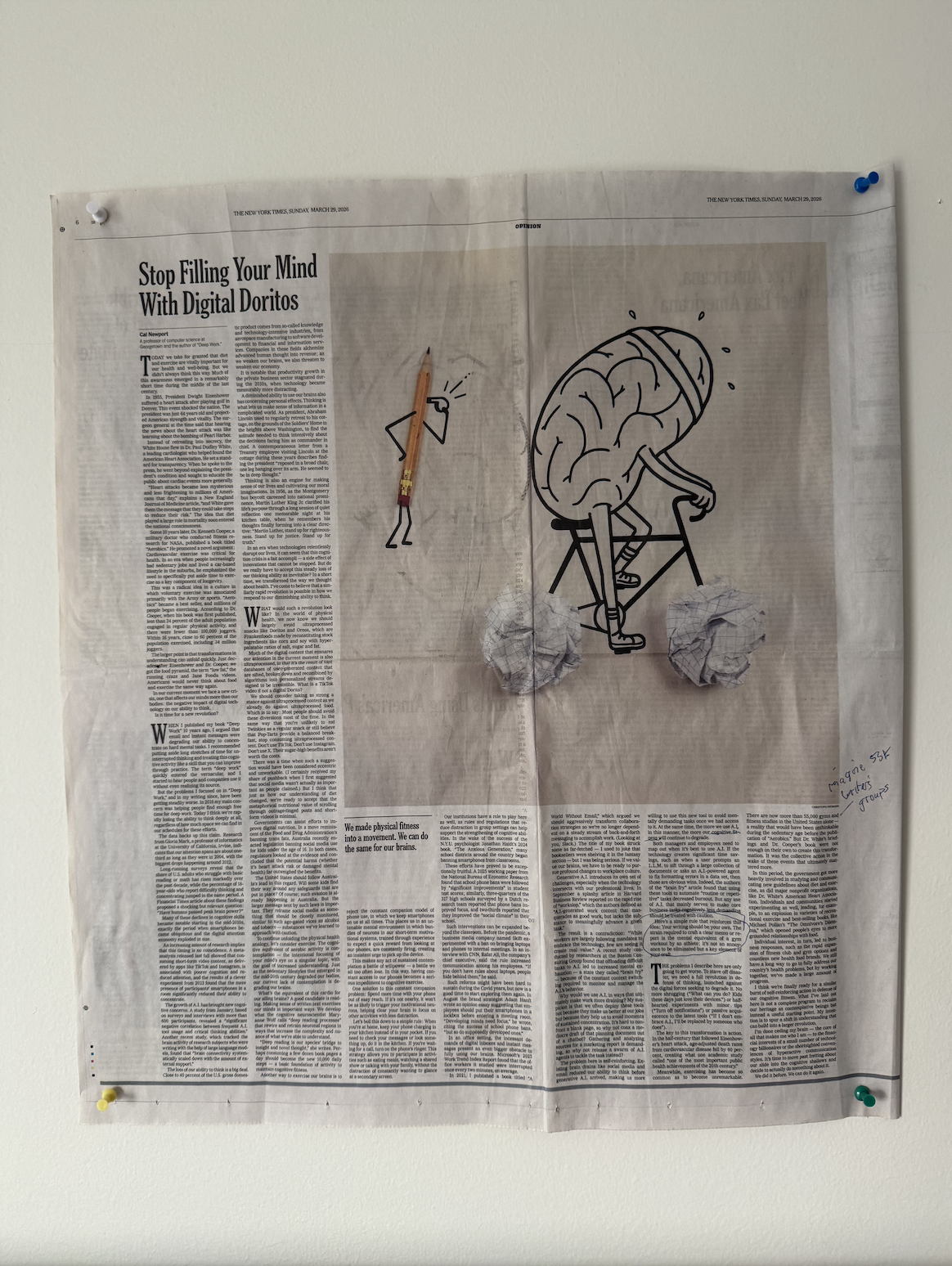
My clipping of Newport’s article
The article is saved from the March 27th copy of the Sunday New York Times, which I still get delivered weekly as one of my favorite rituals: spending the morning on the couch with a cup of coffee surrounded by newsprint and ideas. The piece is written by Cal Newport and titled “There’s a Good Reason You Can’t Concentrate”.
In his essay, Newport calls for a cognitive fitness revolution following the model of the physical fitness revolution of the mid-20th century. As Newport tells the history of the physical fitness revolution, a single book by a military doctor, Aerobics (1968) by Kenneth Cooper, completely changed how people thought about exercise. Before Aerobics was published, less than 24 percent of the adults engaged in regular physical activity and there were fewer than 100,000 joggers. Within 16 years, nearly 60 percent of adults exercised, including 34 million joggers.
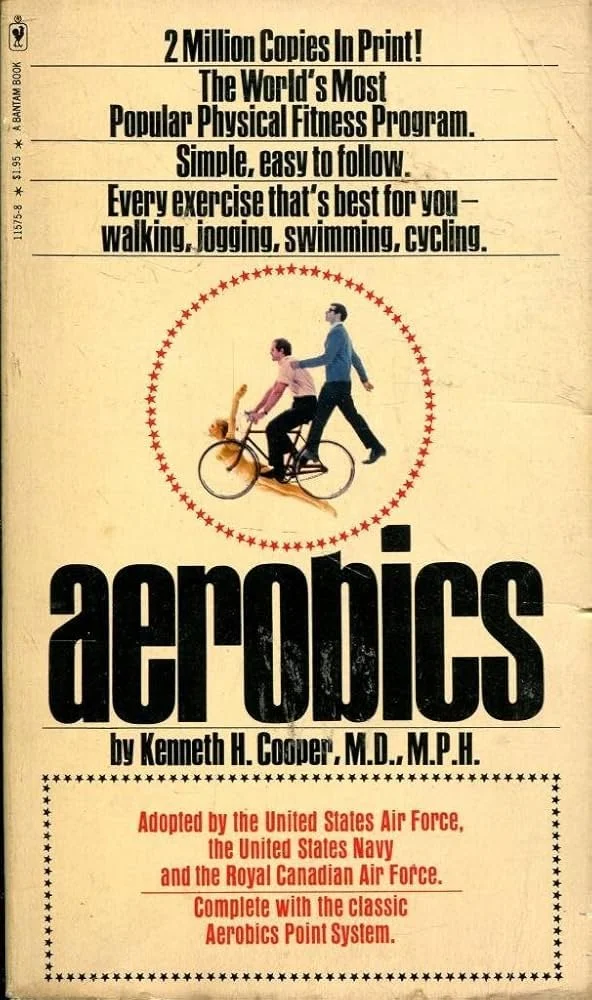
Cooper’s Aerobics
Newport is himself the author of a transformative book: Deep Work: Rules for Focused Success in a Distracted World. Though he’s a computer scientist by training, he has made a career not by boosting the latest technological innovations but by advocating for analog practices of thinking, reading, and writing, that is, deep work. In his NYTimes piece, Newport’s call for a cognitive fitness revolution is positioned as a response to the increased cognitive offloading that results from use of the Internet, social media, and now, generative AI.
These are the sentences I circled in my paper copy of the Newport article:
“Here’s a simple rule that reinforces this idea: Your writing should be your own. The strain required to craft a clear memo or report is the mental equivalent of a gym workout by an athlete; it’s not an annoyance to be eliminated but a key element of your craft.”
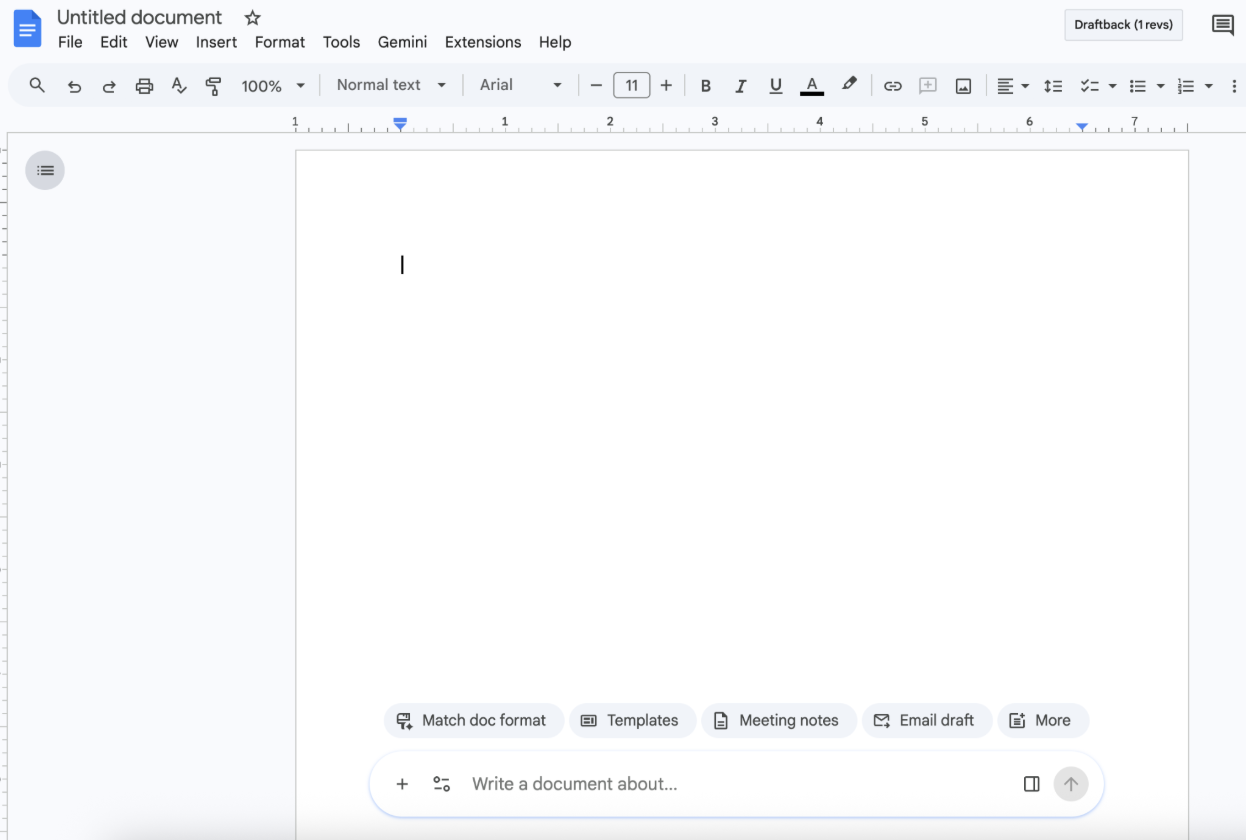
Almost anywhere you type online, AI offers to write for you
As an adjunct English professor, I’ve been concerned about cognitive offloading for some time now. I’ve just recently returned to teaching after a decade working in education technology. The majority of my students are using tools like ChatGPT to varying degrees in their school work. Even though I clearly believe that technology has a role to play in teaching and learning, I was shaken by my students’ adoption of AI. Whereas I had seen a lot of the tools I’d worked on and used in the classroom as stimulating the development of traditional skills like close reading and critical thinking, generative AI seemed to be displacing them.
My response as a writing instructor to this moment of autocomplete everything was similar to Newport’s: go analog. Once a week, I told my students to write for 10 minutes before we started class. I wanted to give them the messy but deeply and personally generative experience of writing from scratch. And not just as a way to learn writing. But as a way to exercise thinking.
Instructors don’t assign essays to students because the world needs more student essays. They assign writing because it’s good for the brain. Writing is really as much about process as it is about product. And if you eliminate the process–ask AI to write for you–you are missing the point. As the sci-fi author Ted Chiang writes in a New Yorker essay, “Using ChatGPT to complete assignments is like bringing a forklift into the weight room; you will never improve your cognitive fitness that way.”
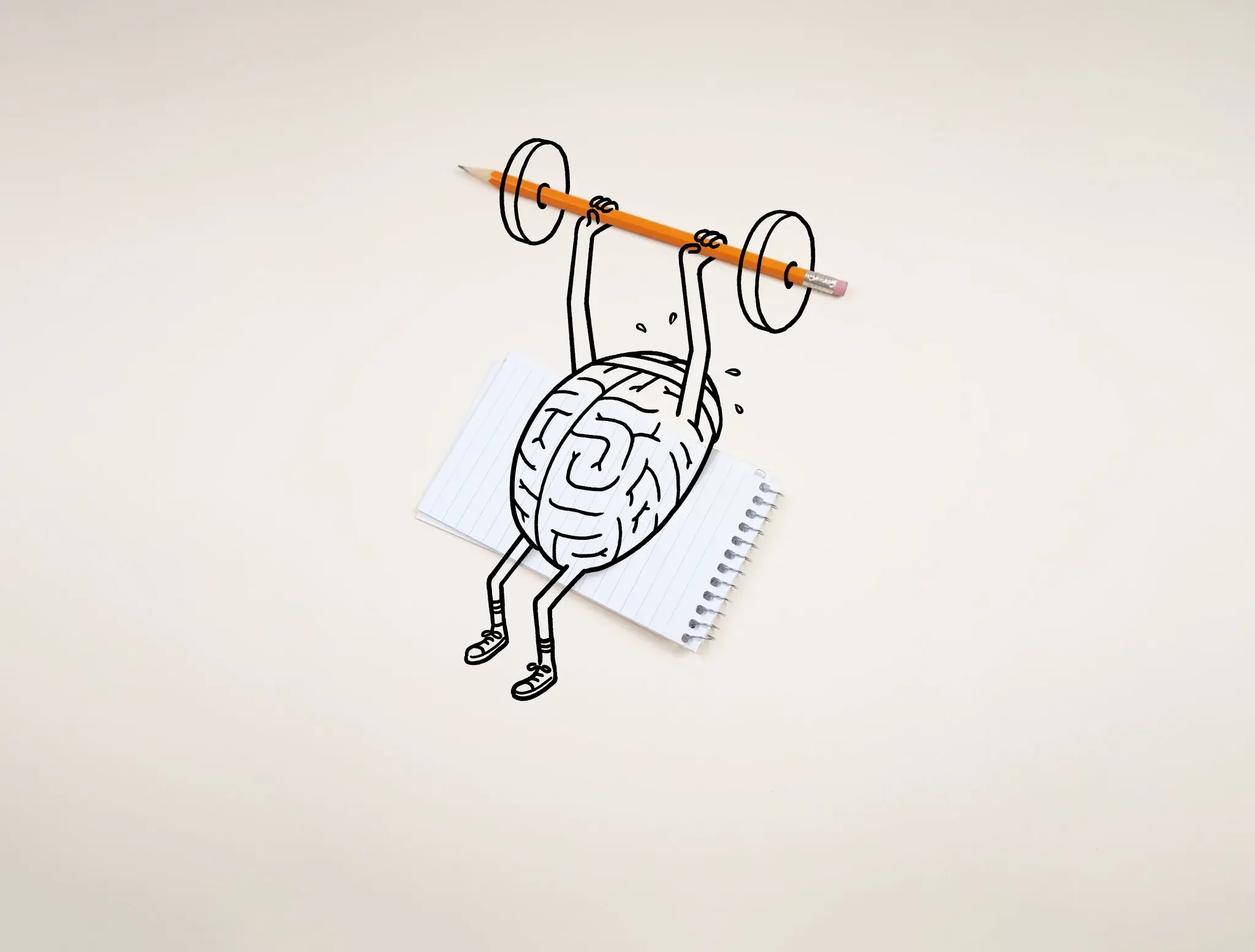
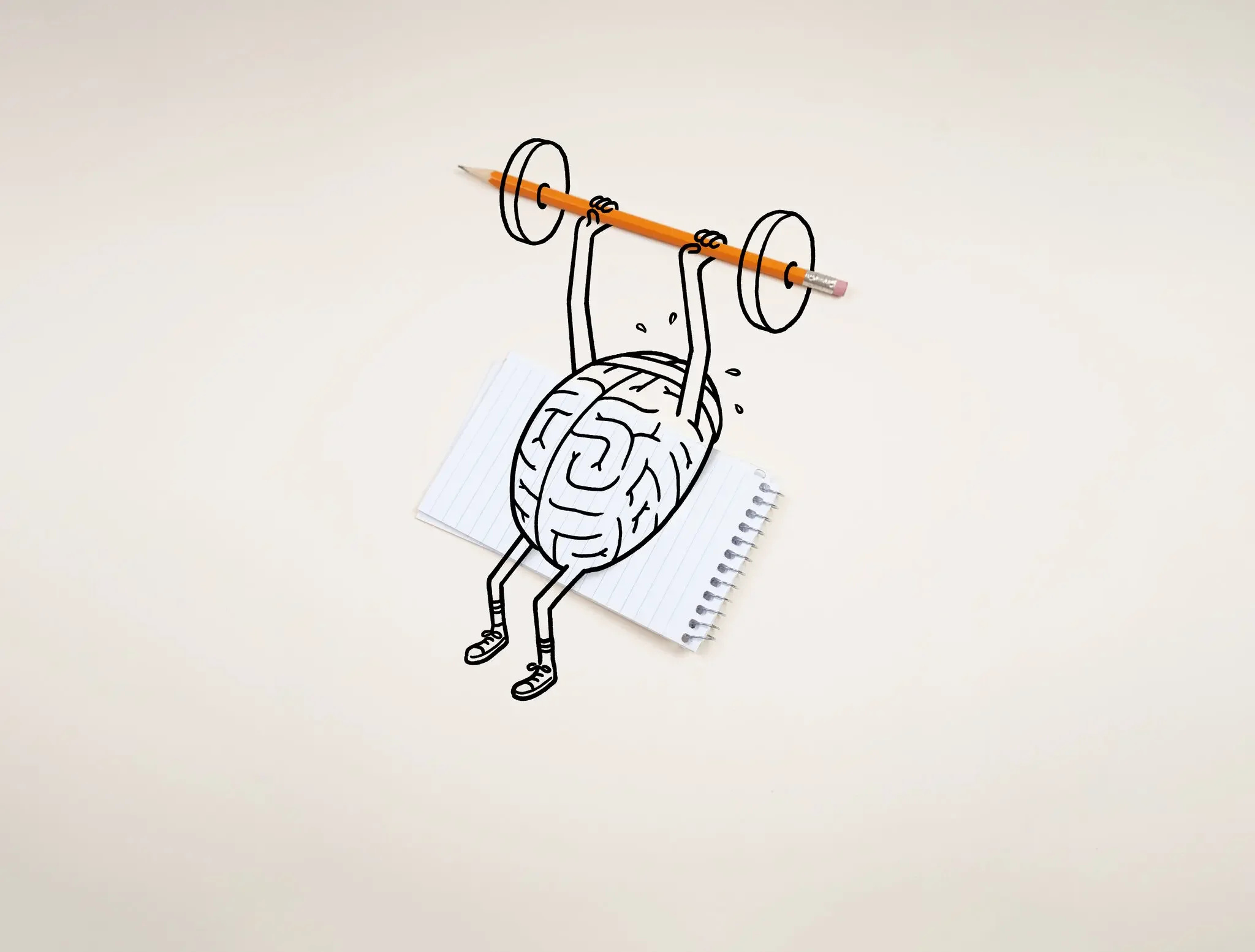
Christoph Niemann image that illustrates the Newport article
All these athletics analopies got me thinking: what if we could do for cognitive fitness what apps like Apple Health and Strava have done for physical fitness? What might an app for the mental sports of reading and writing look like?
As a sometimes writer, my own writing exercise routine is a little like my physical exercises routine. In both cases, I’ve struggled with maintaining a consistent discipline. I’ll buy running shoes, jog regularly for a few months then fall off. I’ll buy a journal, fill it about 75% and then abandon it in a drawer.
With physical fitness, I have found that my Apple Fitness and Strava apps have helped me exercise more consistently. I am motivated to keep my streaks alive thanks to logging and nudging of both apps. I feel validated when my Apple Watch tells me I’ve closed my exercise circle. And I am eager to log my bike rides on Strava and see others “like” my posts. Maybe similar mechanisms could help myself and others become more regular writers.
Writually aspires to be a multi-sport gymnasium for the mind. We’re starting with writing as one of our most direct pathways into our thinking as humans.
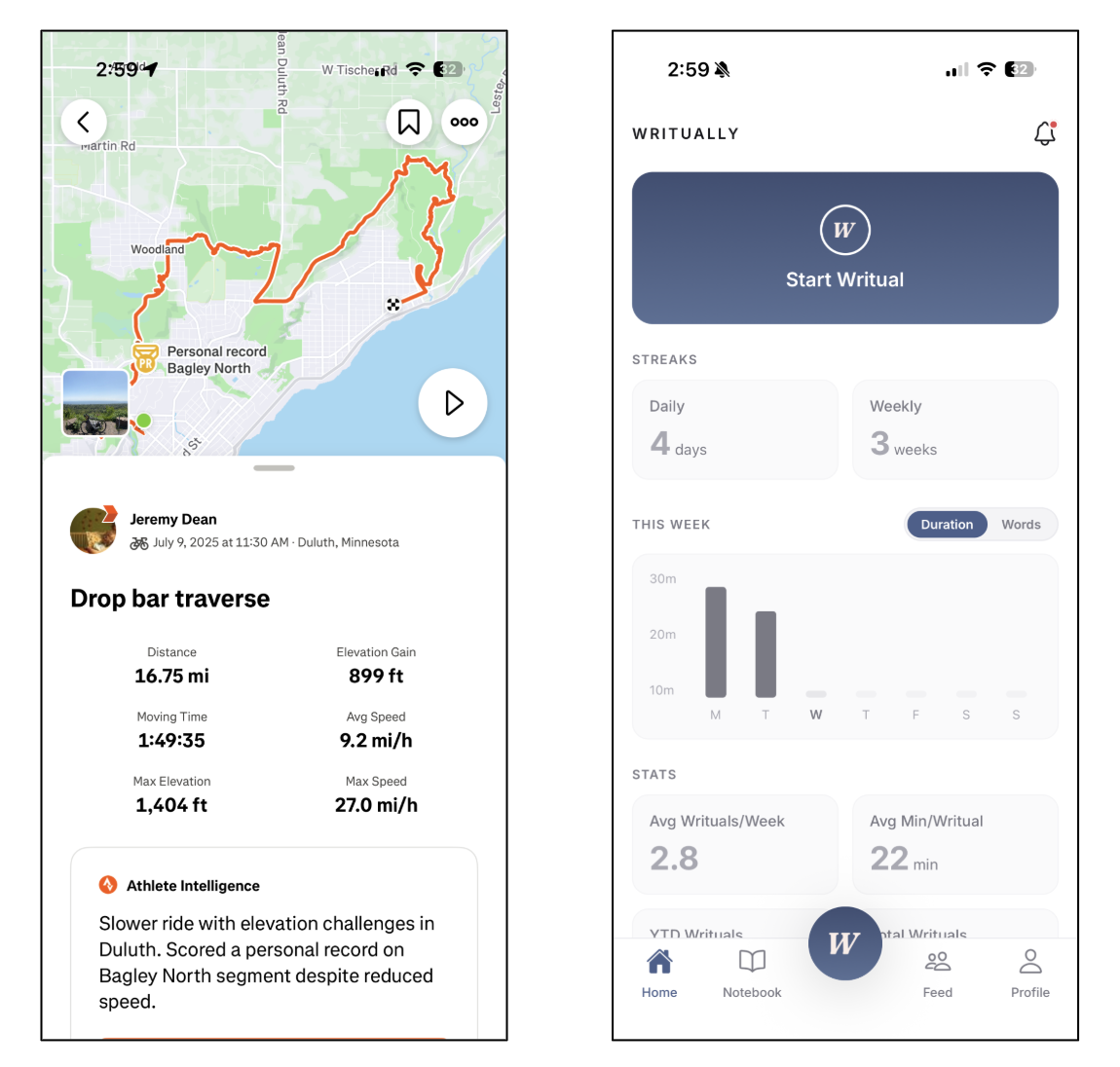
Writually as Strava for writing
Apple Watch and iOS app for Strava do not simulate the embodied experience of physical exercise. Unlike many other apps on our phones that demand all attention be paid to them, fitness apps require something of us in the real world. So too with Writually: it begins with longhand writing with pen on paper–eventually we plan to include nice pens and journals as part of some subscription tiers. We believe non-keyboard based writing practice is key to slowing the mind in the way needed for deep reflection.
As with fitness apps, Writually moves from the physical world to digital to leverage technological affordances to motivate the writer. Part of that is a metrics game: streaks of writing sessions, session duration, and session word count. Writing sessions, or “writuals,” are like “activities” in Strava. The duration and word count of sessions like “distance” and “moving time.” Our theory is that this slight gamification provides a little nudge to write regularly, while the page and the practice remain the users beyond the stats.
Another key motivating factor for writing is feedback. In addition to digitizing the user’s longhand writing, Writually provides an AI-powered reflection including highlighting quotes, themes, and tensions within each entry logged. There is no doubt a tension at the core of Writually as it celebrates the analog and rallies against cognitive offloading while at the same time embraces artificial intelligence as a thought partner. We have been especially careful with how we’ve integrated AI into the system so as not to surrender the reflective part of writing practice.
The second marginalia in my physical copy of the NYTimes piece is a handwritten note: “Imagine 53K writers’ groups” next to this sentence:
“[E]xercising has become so common as to become unremarkable. There are now more than 55,000 gyms and fitness studios in the United States alone — a reality that would have been unthinkable during the sedentary age before the publication of “Aerobics.” ”
Being able to discover and join writers’ groups is a long time goal of Writually. We’ll start with a minimal set of social features that will make Writually feel communal in the way a workout class feels like a community: a feed of your and your followers' activities, the ability to share your streaks and snitpits of your writing itself. We want to be cautious as we are very aware of the failings of so-called social media in creating authentic, healthy communities. But we do believe writing “with” others can help motivate people, hold them accountable, and, simply, make it fun.
So Writually is another app on your phone, sorry, Cal. More than that, though, Writually is a system in which the app is just a part. Your mind, your notebook and pen, the space and time you create to write, is part of it too. Above all, though, Writually is a movement. We are concerned about our cognitive health and that of our families and friends. We want to keep human practices of reading, writing, and thinking alive. This is us digging out the old jogging shoes from the back of the closet, but this time we have a plan.