
How Writually Began with a Newspaper Article, a Pen, and a Marginal Note
At the moment, there is a clipped newspaper article on the wall above my desk held in place by pushpins. It is creased from folding, already yellowing from sunlight though just a month old, and marked up by a pen. Next to a paragraph about the mental effort of writing, I have circled a couple of sentences with pen ink. Later in the article, I wrote a note to myself. These marginalia eventually became Writually.
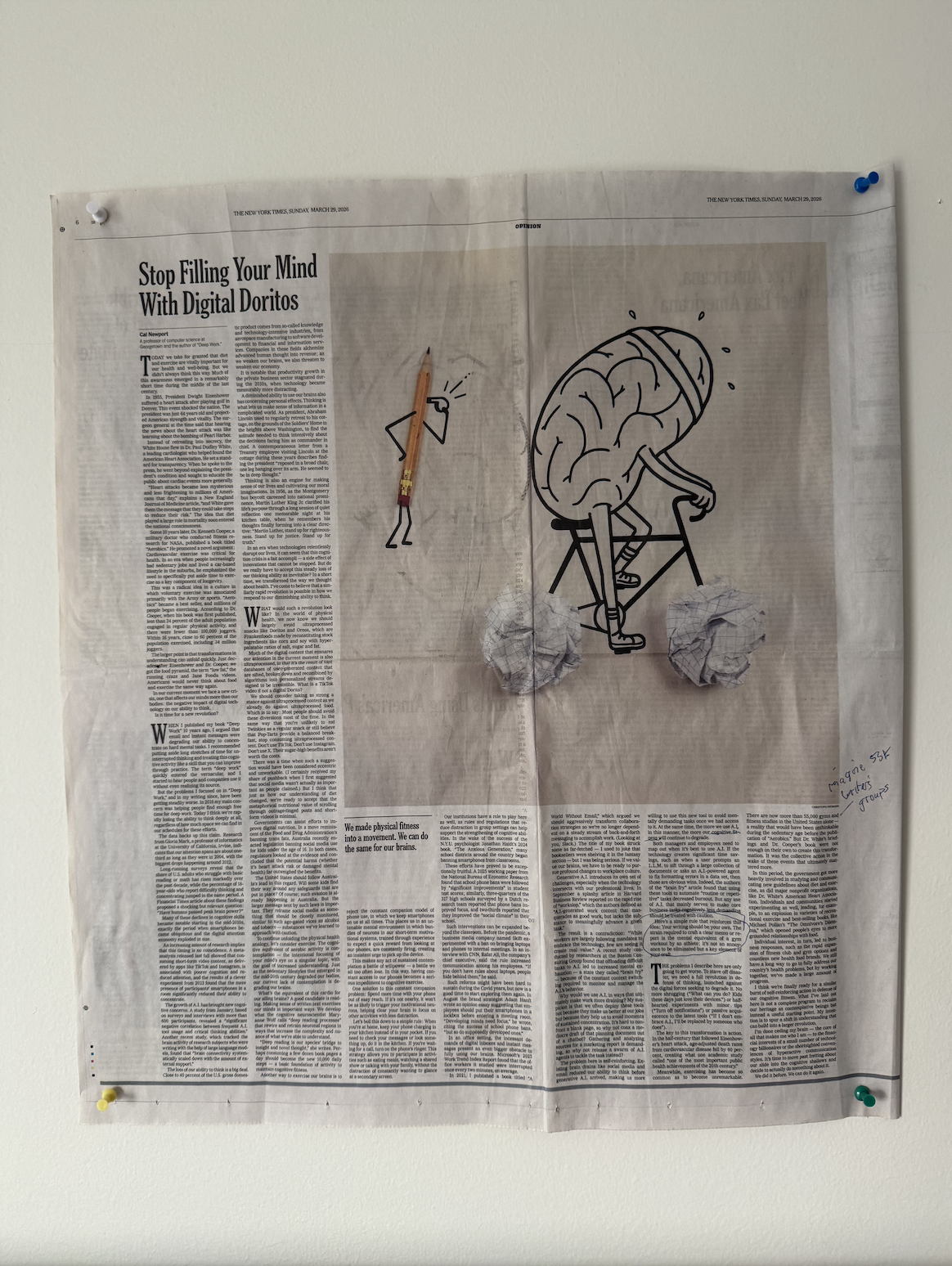
My clipping of Newport’s article
The article is saved from the March 27th copy of the Sunday New York Times, which I still get delivered weekly as one of my favorite rituals: spending the morning on the couch with a cup of coffee surrounded by newsprint and ideas. The piece is written by Cal Newport and titled “There’s a Good Reason You Can’t Concentrate”.
In his essay, Newport calls for a cognitive fitness revolution following the model of the physical fitness revolution of the mid-20th century. As Newport tells the history of the physical fitness revolution, a single book by a military doctor, Aerobics (1968) by Kenneth Cooper, completely changed how people thought about exercise. Before Aerobics was published, less than 24 percent of the adults engaged in regular physical activity and there were fewer than 100,000 joggers. Within 16 years, nearly 60 percent of adults exercised, including 34 million joggers.
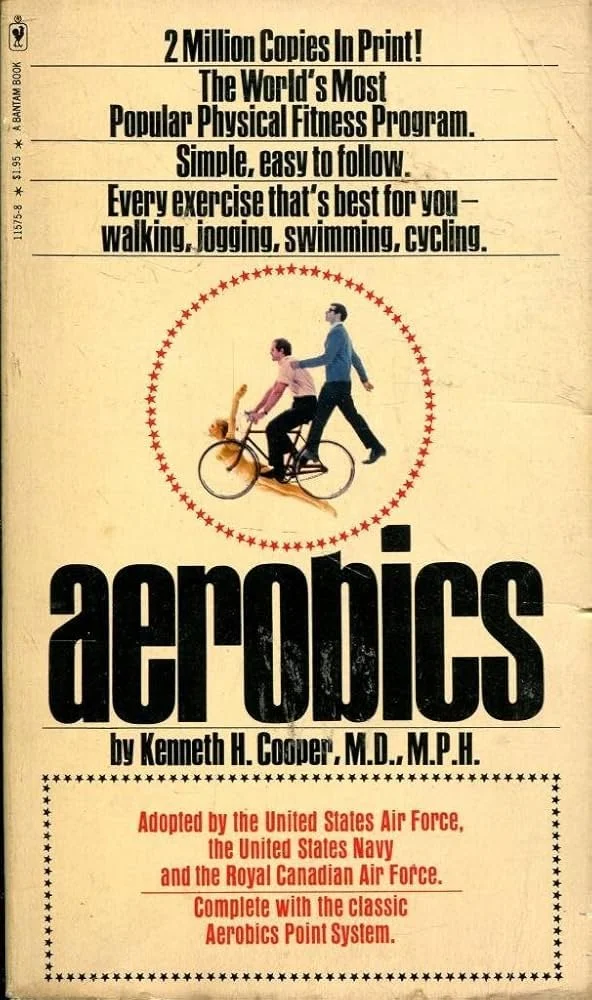
Cooper’s Aerobics
Newport is himself the author of a transformative book: Deep Work: Rules for Focused Success in a Distracted World. Though he’s a computer scientist by training, he has made a career not by boosting the latest technological innovations but by advocating for analog practices of thinking, reading, and writing, that is, deep work. In his NYTimes piece, Newport’s call for a cognitive fitness revolution is positioned as a response to the increased cognitive offloading that results from use of the Internet, social media, and now, generative AI.
These are the sentences I circled in my paper copy of the Newport article:
“Here’s a simple rule that reinforces this idea: Your writing should be your own. The strain required to craft a clear memo or report is the mental equivalent of a gym workout by an athlete; it’s not an annoyance to be eliminated but a key element of your craft.”
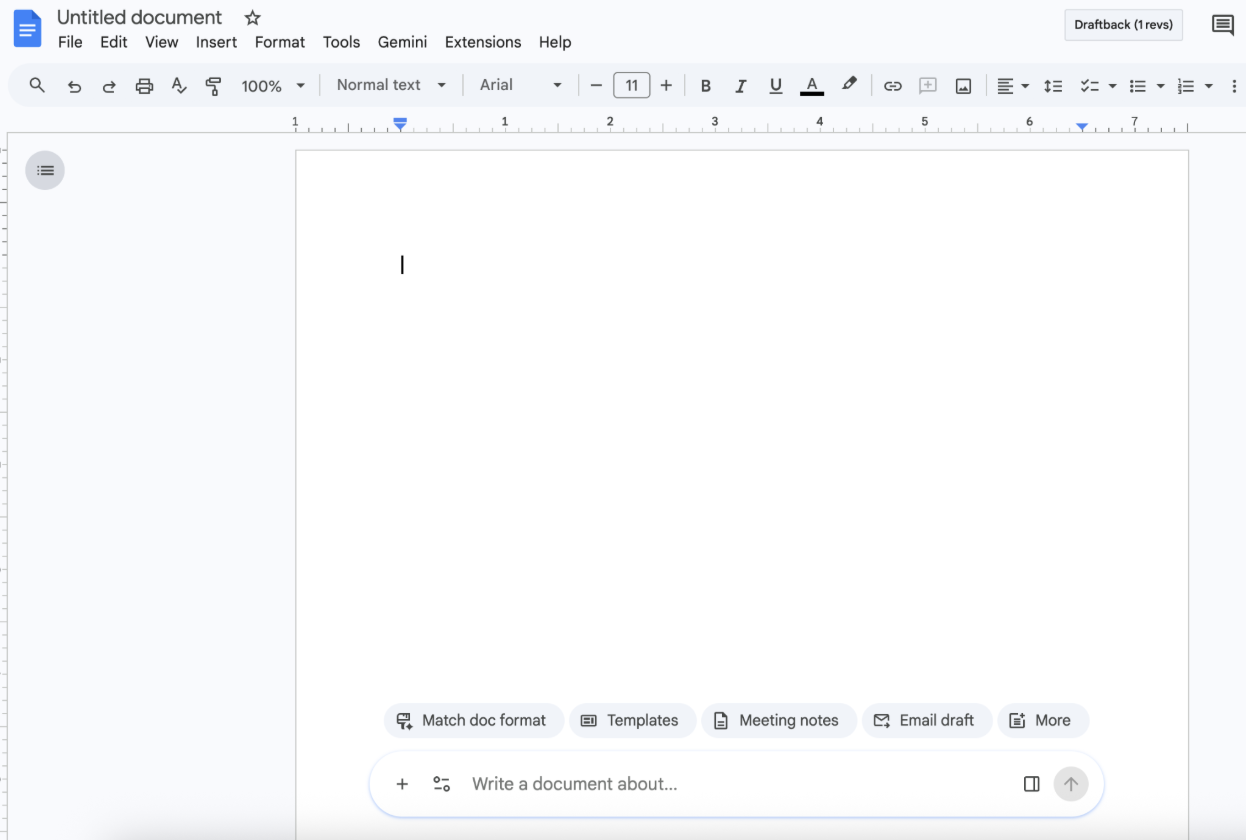
Almost anywhere you type online, AI offers to write for you
As an adjunct English professor, I’ve been concerned about cognitive offloading for some time now. I’ve just recently returned to teaching after a decade working in education technology. The majority of my students are using tools like ChatGPT to varying degrees in their school work. Even though I clearly believe that technology has a role to play in teaching and learning, I was shaken by my students’ adoption of AI. Whereas I had seen a lot of the tools I’d worked on and used in the classroom as stimulating the development of traditional skills like close reading and critical thinking, generative AI seemed to be displacing them.
My response as a writing instructor to this moment of autocomplete everything was similar to Newport’s: go analog. Once a week, I told my students to write for 10 minutes before we started class. I wanted to give them the messy but deeply and personally generative experience of writing from scratch. And not just as a way to learn writing. But as a way to exercise thinking.
Instructors don’t assign essays to students because the world needs more student essays. They assign writing because it’s good for the brain. Writing is really as much about process as it is about product. And if you eliminate the process–ask AI to write for you–you are missing the point. As the sci-fi author Ted Chiang writes in a New Yorker essay, “Using ChatGPT to complete assignments is like bringing a forklift into the weight room; you will never improve your cognitive fitness that way.”
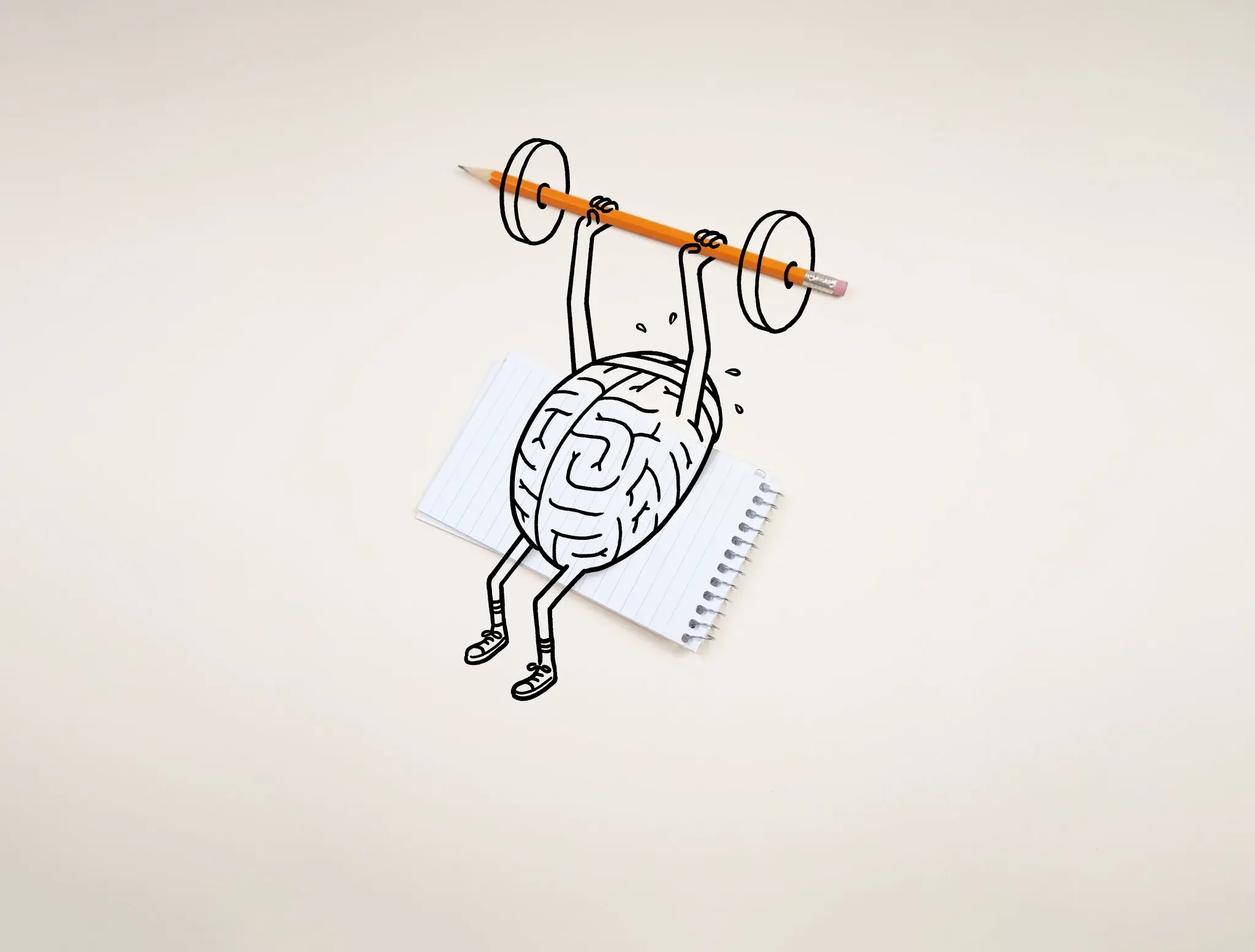
Christoph Niemann image that illustrates the Newport article
All these athletics analopies got me thinking: what if we could do for cognitive fitness what apps like Apple Health and Strava have done for physical fitness? What might an app for the mental sports of reading and writing look like?
As a sometimes writer, my own writing exercise routine is a little like my physical exercises routine. In both cases, I’ve struggled with maintaining a consistent discipline. I’ll buy running shoes, jog regularly for a few months then fall off. I’ll buy a journal, fill it about 75% and then abandon it in a drawer.
With physical fitness, I have found that my Apple Fitness and Strava apps have helped me exercise more consistently. I am motivated to keep my streaks alive thanks to logging and nudging of both apps. I feel validated when my Apple Watch tells me I’ve closed my exercise circle. And I am eager to log my bike rides on Strava and see others “like” my posts. Maybe similar mechanisms could help myself and others become more regular writers.
Writually aspires to be a multi-sport gymnasium for the mind. We’re starting with writing as one of our most direct pathways into our thinking as humans.
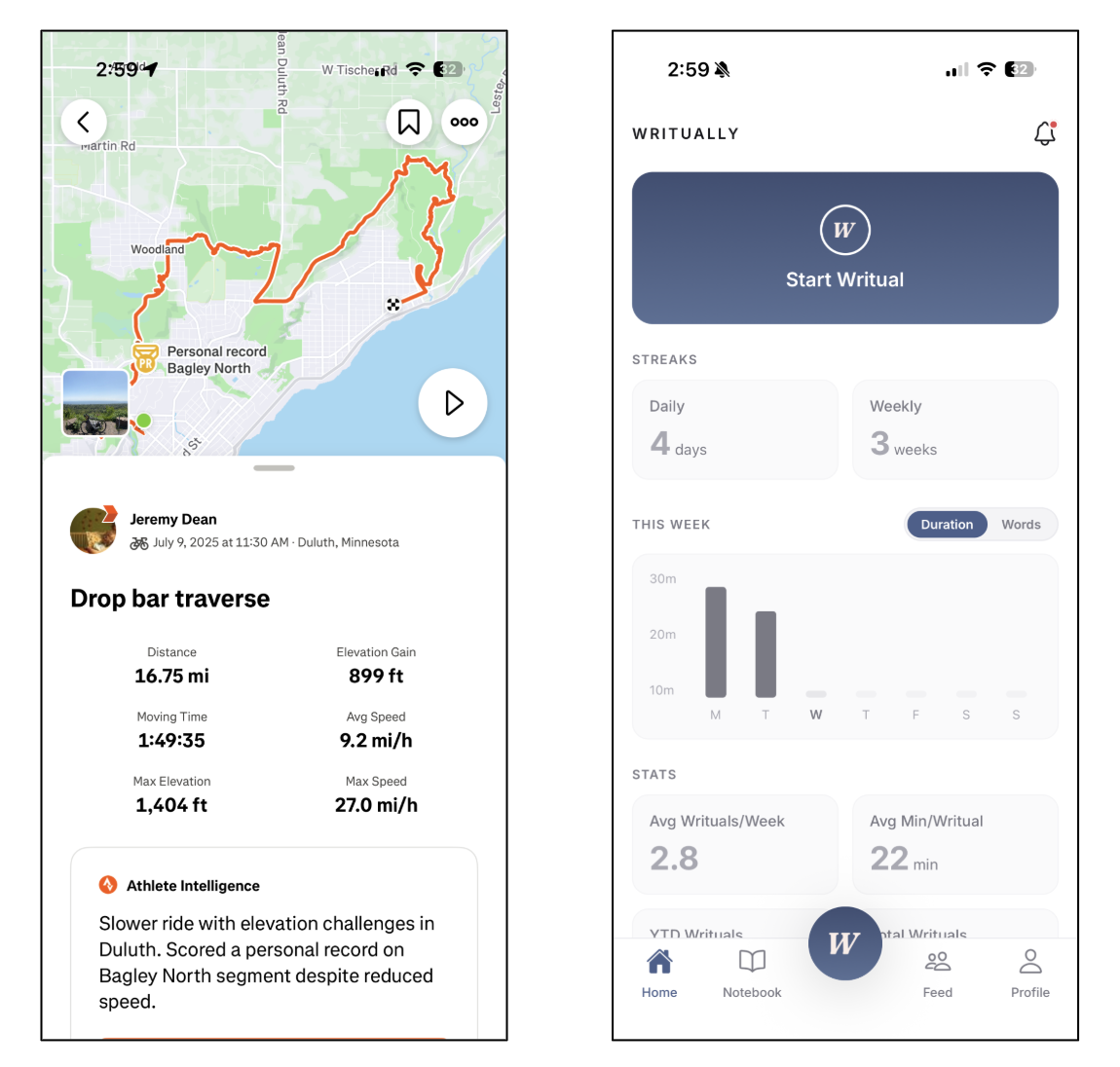
Writually as Strava for writing
Apple Watch and iOS app for Strava do not simulate the embodied experience of physical exercise. Unlike many other apps on our phones that demand all attention be paid to them, fitness apps require something of us in the real world. So too with Writually: it begins with longhand writing with pen on paper–eventually we plan to include nice pens and journals as part of some subscription tiers. We believe non-keyboard based writing practice is key to slowing the mind in the way needed for deep reflection.
As with fitness apps, Writually moves from the physical world to digital to leverage technological affordances to motivate the writer. Part of that is a metrics game: streaks of writing sessions, session duration, and session word count. Writing sessions, or “writuals,” are like “activities” in Strava. The duration and word count of sessions like “distance” and “moving time.” Our theory is that this slight gamification provides a little nudge to write regularly, while the page and the practice remain the users beyond the stats.
Another key motivating factor for writing is feedback. In addition to digitizing the user’s longhand writing, Writually provides an AI-powered reflection including highlighting quotes, themes, and tensions within each entry logged. There is no doubt a tension at the core of Writually as it celebrates the analog and rallies against cognitive offloading while at the same time embraces artificial intelligence as a thought partner. We have been especially careful with how we’ve integrated AI into the system so as not to surrender the reflective part of writing practice.
The second marginalia in my physical copy of the NYTimes piece is a handwritten note: “Imagine 53K writers’ groups” next to this sentence:
“[E]xercising has become so common as to become unremarkable. There are now more than 55,000 gyms and fitness studios in the United States alone — a reality that would have been unthinkable during the sedentary age before the publication of “Aerobics.” ”
Being able to discover and join writers’ groups is a long time goal of Writually. We’ll start with a minimal set of social features that will make Writually feel communal in the way a workout class feels like a community: a feed of your and your followers' activities, the ability to share your streaks and snitpits of your writing itself. We want to be cautious as we are very aware of the failings of so-called social media in creating authentic, healthy communities. But we do believe writing “with” others can help motivate people, hold them accountable, and, simply, make it fun.
So Writually is another app on your phone, sorry, Cal. More than that, though, Writually is a system in which the app is just a part. Your mind, your notebook and pen, the space and time you create to write, is part of it too. Above all, though, Writually is a movement. We are concerned about our cognitive health and that of our families and friends. We want to keep human practices of reading, writing, and thinking alive. This is us digging out the old jogging shoes from the back of the closet, but this time we have a plan.
